The Web Is Forking: How Stripe's Agentic Commerce Stack Is Shifting Power From Sellers to Buyers
Stripe's agentic commerce stack is moving payment authority from seller-controlled checkout pages to buyer-controlled wallets, changing how online commerce works.
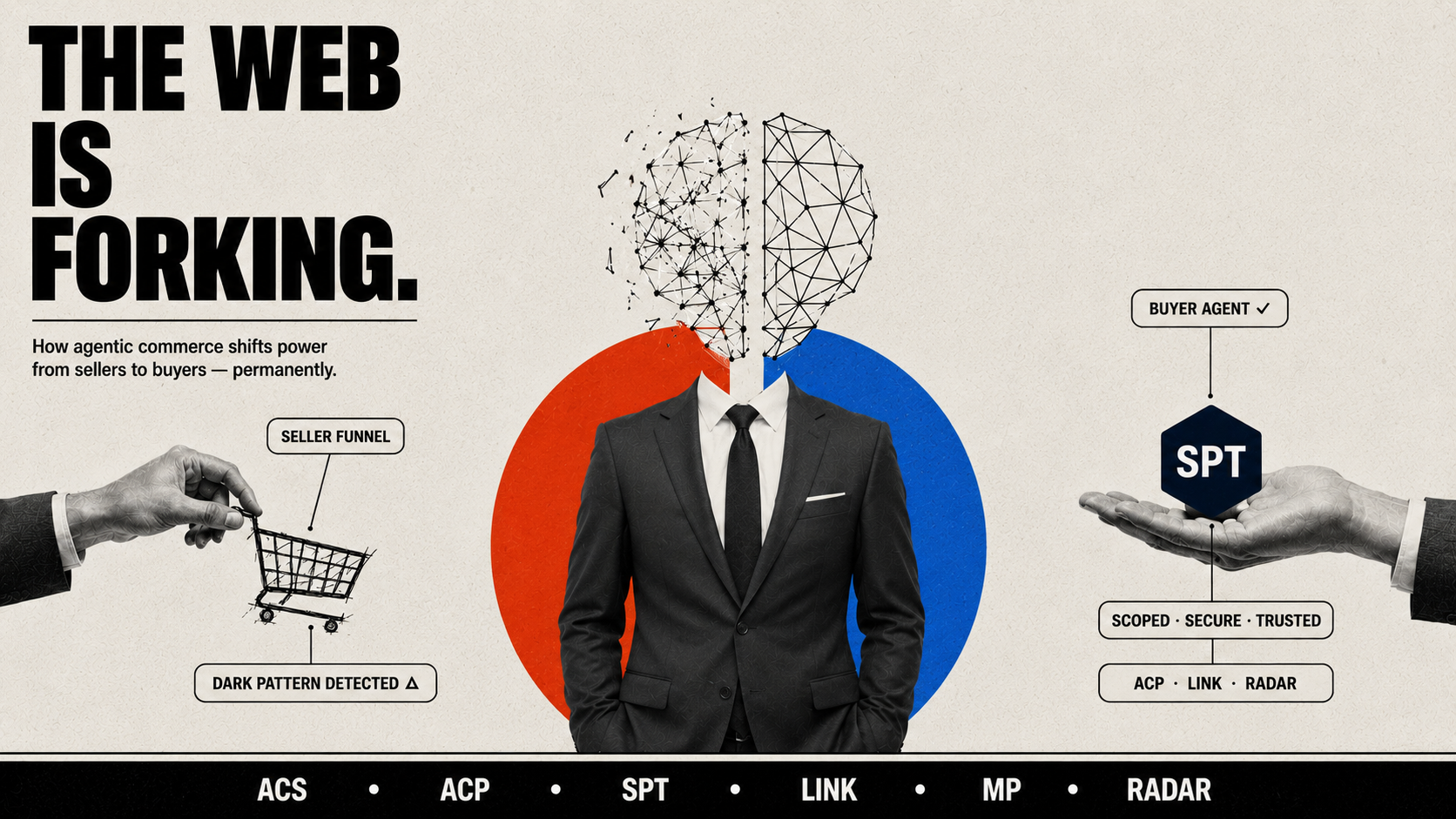
The web is forking. One branch for humans. One for agents. Stripe just built the rails for the second branch, and it changes who controls the economic relationship in commerce for the first time in 20 years.
This isn't about agents buying coffee. It's about payment authority leaving the seller's checkout page and moving permanently to the buyer's wallet.
The Old Web: Two Decades of Engineered Seller Advantage
Here's the uncomfortable truth about e-commerce: it was never designed to serve buyers. It was designed to convert them.
The numbers make this concrete. The average e-commerce checkout abandonment rate sits at 70%. Retargeting ad spend in the US alone crossed $16B in 2024, entirely dedicated to recovering buyers who already left. Subscription companies collectively bank on the fact that 70% of consumers say they've paid for a subscription they forgot they had. Dark patterns, pre-checked upsells, hidden fees revealed at the final step, countdown timers that reset on refresh, aren't bugs in the system. They're the system.
Stripe's original genius was making the end of that funnel frictionless. One API call, money moved. But the funnel itself, the discovery, the manufactured urgency, the moment of credential entry, still belonged to the seller.
Agentic commerce dismantles this at the root.
The Fork: One Web for Humans, One for Agents
The best framing here comes from analyst Nate Jones: the web is forking.
One branch continues as today's web, built for human eyes, human impatience, human susceptibility to urgency tactics. Landing pages, retargeting pixels, abandoned-cart emails, countdown timers. All of it optimized for the moment a tired human makes a suboptimal decision.
The other branch is agent-native: structured APIs, machine-readable policies, programmatic payment primitives. Built for software acting on behalf of humans, software that doesn't feel urgency, doesn't respond to "LIMITED TIME ONLY," and doesn't forget a bad experience.
This isn't a metaphor. When a buyer tells their AI assistant, "find me authentic Ethiopian coffee under $30, ships in 2 days," the agent doesn't browse websites. It queries structured endpoints, compares machine-readable catalogs, and arrives at a merchant already carrying a pre-authorized payment token scoped to that exact task.
By the time the seller sees traffic, it's not a browsing session. It's an authorized purchasing attempt with constraints, preferences, and payment attached.
Traditional SEO, landing page optimization, on-site persuasion, dramatically less important. What matters instead: is your business callable by agents?
Stripe's Agentic Commerce Stack: What They Actually Built
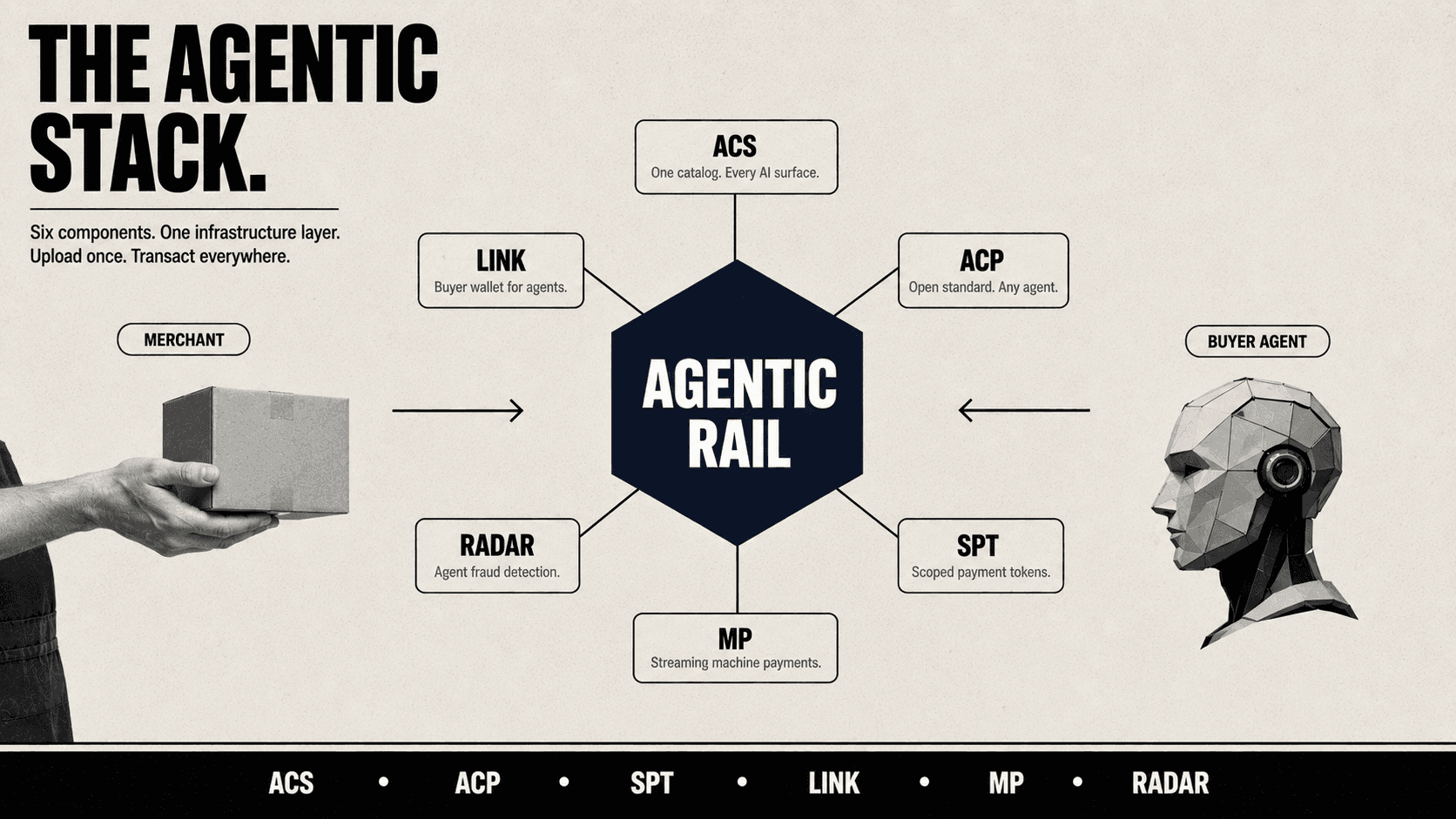
Stripe isn't building the agent. They're building the rails every agent runs on. Six components, one infrastructure layer.
1. Agentic Commerce Suite
Upload your catalog once to Stripe. Stripe hosts an Agentic Commerce Protocol endpoint that ChatGPT, Gemini, Copilot, Meta, and Perplexity can all query for real-time product, price, and availability data. You pick which platforms see your products from the Stripe dashboard, and Stripe handles every format difference and distribution detail.
The real problem this solves: today, a retailer who wants to be discoverable across five AI platforms builds and maintains five incompatible catalog feeds. Agentic Commerce Suite collapses that into one integration.
2. Agentic Commerce Protocol
Agentic Commerce Protocol is an open standard co-developed with OpenAI. It defines how agents and merchants complete a transaction end-to-end: product discovery, order creation, shipping, taxes, payment delegation. Crucially, it's payment-processor agnostic: any payment service provider can implement it. Stripe is the reference implementation and the fastest on-ramp.
"Buy it in ChatGPT" with inline checkout is Agentic Commerce Protocol plus Stripe in production.
3. Shared Payment Tokens
This is where the power shift becomes structural, not theoretical.
A Shared Payment Token is a scoped grant to use a buyer's payment method, issued by an agent to a specific seller, bounded by amount, currency, merchant identity, and expiry. The seller confirms a PaymentIntent against it. Stripe clones the underlying payment method behind the scenes. The merchant never sees raw card details.
Why it matters: payment authority has permanently left the seller's checkout page. Historically, the merchant owned the moment credentials were entered. They controlled the UX, the upsells, the timing. With Shared Payment Tokens, the buyer's wallet issues bounded tokens to chosen merchants based on buyer-defined policy. The agent enforces spending limits and merchant allow-lists before the seller sees a transaction.
The checkout page you spent 18 months A/B testing is no longer where the purchase decision lives.
4. Link Wallet for Agents
Stripe's consumer wallet, Link, is now programmatically accessible to AI agents. The buyer authorizes spend within defined bounds: amount limits, frequency caps, merchant allow-lists. Link returns either a one-time virtual card or a Shared Payment Token. The agent never handles raw credentials.
The buyer's wallet becomes their persistent payment identity across every AI surface, ChatGPT, Gemini, Copilot, regardless of which agent initiates the purchase.
5. Machine Payments Protocol
Agentic Commerce Protocol handles shopping. Machine Payments handles ongoing economic relationships between agents and services.
Built with partners like Tempo, Machine Payments enables stablecoin-based streaming payments where money moves in near-real-time as value is delivered. Agents pay per query, per token, per API call, or on conditional mandates: "pay only if the result passes an evaluation." Monthly subscription billing is a blunt instrument for AI-native workloads. Machine Payments is the sharp one.
This is Stripe positioning itself as the settlement layer for machine-to-machine commerce, a market that doesn't exist at scale yet but will.
6. Radar for Agents
Giving millions of agents payment authority creates a new attack surface for millions of malicious agents. Stripe extends Radar to model AI usage patterns, token consumption, and agent behavior network-wide, catching fraud schemes invisible to any individual merchant.
This is non-negotiable infrastructure. Without it, Shared Payment Tokens become an attack vector and the whole system becomes economically untenable.
The Power Shift: Four Ways Buyers Win
Strip away the technology and this is a story about power moving from one side of the transaction to the other.
Discovery Moves From Seller Funnels to Agent Feeds
Today, sellers control discovery through paid ads and engineered landing pages, all optimized to keep you on their property. Tomorrow, buyers describe tasks to agents, agents query structured feeds across every merchant simultaneously, and the agent optimizes for the buyer's constraints, not the seller's conversion rate.
Agents don't click on sponsored results. They don't respond to urgency. They compare everything, rationally, in parallel.
Payment Authority Lives With the Buyer
The seller's checkout page was where payment credentials lived. That's the moment sellers owned. They controlled the UX, timing, upsell placement, the subtle friction that made canceling harder than continuing. With Shared Payment Tokens and Link for agents, buyers approve spend in their own wallet. The agent arrives at the merchant already holding a bounded payment instrument.
The merchant still fulfills the order. But they no longer own the moment of credential collection. That's a durable, structural shift in negotiating power, not a UX change.
Brand Becomes Memory, Not Performance
Agents don't feel nostalgia. They don't respond to brand storytelling or a beautiful landing page. But they encode brand as persistent preferences: trusted vendors, blocked merchants, service history, reliability scores.
One bad experience, hidden fees, unreliable shipping, deliberately difficult returns, can become a soft ban that follows the buyer across every agent and platform they ever use. Brand becomes less about the impression you engineer and more about the reliability you actually deliver. Dark patterns don't just fail to work anymore. They actively destroy your agent discoverability.
New Models Pay for Outcomes, Not Presence
Machine Payments enable billing where buyers pay only when value is delivered, per query, per outcome, per unit. Agents can manage task-scoped budgets across dozens of services, automatically capping or canceling relationships that miss thresholds.
Stripe is making these granular, buyer-favorable contracts first-class capabilities. The SaaS subscription model that profits from inertia and cancellation friction doesn't survive contact with an agent that manages all your subscriptions automatically.

The Five Levels of Agentic Commerce
Stripe and ecosystem analysts outline an evolution through five levels:
- Form-filling: agents autofill existing checkout pages. Today's reality.
- Structured discovery: agents query machine-readable catalogs and compare merchants in parallel. Agentic Commerce Suite enables this.
- Delegated payment: agents carry scoped tokens; checkout becomes invisible. Shared Payment Tokens plus Agentic Commerce Protocol. Shipping now.
- Continuous relationships: agents manage streaming, usage-based billing autonomously. Machine Payments plus streaming. Shipping now.
- Anticipatory commerce: agents predict needs and execute purchases before the buyer asks. The horizon.
Most companies talk about this as 2030 technology. Stripe is shipping levels 2 through 4 in 2026.
What Builders and Merchants Should Do
If you build or sell online, one question replaces all others: can your business be called by agents?
Being callable means an agent can programmatically understand what you sell, read your policies and pricing, compare you against every alternative, and execute a complete path from intent to payment and fulfillment, without a human ever touching a checkout page.
The checklist is short:
Make your catalog agent-readable. Structured data, explicit attributes, real-time availability. Integrate Agentic Commerce Suite so Stripe distributes it across every AI surface for you.
Integrate Agentic Commerce Protocol and Shared Payment Tokens now, not when volumes justify it. Being first-class in agent feeds compounds. Late adopters become invisible as agent traffic scales.
Shift to outcome-based billing. Usage-based and streaming models via Stripe Billing and Machine Payments aren't just more agent-friendly, they signal that your business is built for how agents actually transact.
Harden against agent-scale fraud. Traditional fraud detection models human behavior. Agent fraud is automated, relentless, and arrives at a scale no human team can manually review. Radar's agent models are not optional.
Stop optimizing for human persuasion. Dark patterns, urgency triggers, UX friction, these work on humans. Agents route around them, remember them, and penalize you for them permanently.
The Bigger Picture
Stripe's strategy is an infrastructure play in its purest form. They're not building the agent. They're not owning the discovery surface. They're building the rails so that whoever wins the agent interface war, OpenAI, Google, Microsoft, Meta, or someone not yet founded, merchants and buyers can still transact through a consistent, secure, programmable layer.
This extends Stripe's original mission, making money movement feel native to software, into a world where software doesn't just run businesses, it acts as the buyer.
The web is forking. The fork is happening now. The only question is whether your business is built for the branch that matters.
Sources
This analysis draws on Stripe's Sessions 2026 announcements, Nate Jones's analysis of agentic commerce, Stripe's published technical documentation, and primary research across the emerging agentic commerce ecosystem.